| Page 1.
|
|
Personal psychology of Greek mythological gods. |
-
Human personality according to concepts of analytical psychology of Carl
Gustav Jung has mental functions according to which any person perceives
universe. Also human personality has attributes introversion or extraversion,
namely psychophysical orientations or vectors according to which mental
functions are focused on perception of external objective validity or internal
subjective reality.
Variants of psychophysical orientations of human personality can be correlated
to a magic square or otherwise to tell mathematical matrix which is shown on the chart.
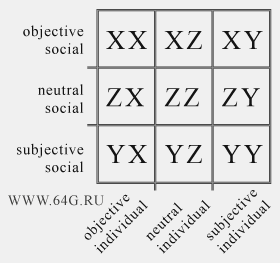 |
Letter X - extraversion - objective perception of world validity. |
-
Top horizontal - objective social - extraversion.
Extraverts aspire to significant position in society.
Bottom horizontal - subjective social - introversion.
Introverts avoid significant position in society.
Middle horizontal - neutral social - equaversion.
Equaverts are indifferent to public value of own person.
Left vertical - objective individual - extraversion.
Extraverts draw common attention to own person and consider personal opinions of people.
Right vertical - subjective individual - introversion.
Introverts avoid attention to own person and do not consider personal opinions of people.
Middle vertical - neutral individual - equaversion.
Equaverts are indifferent to common attention and personal opinions of people.
Total according to verticals and horizontals, also left and right letters each
cell of magic square is coordinated with individual and social displays of human
personality. Namely each cell of magic square corresponds with two
psychophysical orientations according to which mental functions are focused on
perception of external objective validity or internal subjective reality, that
is comparable to characteristics of mythological gods of Ancient Greece and
esoteric values of numbers in Pythagorean numerology.
XX
Objective social extraversion.
Objective individual extraversion.
Number 6 - Zeus aspires to significant position in society and draws
attention to own person, that are attributes of extraversion according to public
and individual displays of personality, because he is Supreme god of Olympic
pantheon in Greek mythology.
Number 4 - Hera possesses similar psychological parameters of
personality, because she is wife of Zeus and Supreme goddess in the context of
Greek mythology.
YY
Subjective social introversion.
Subjective individual introversion.
Number 4 - Leto avoids significant position in society and attention to
own person, because she is mythological goddess who relies on high social status
of her children and does not influence world events. Namely Leto exists in
hierarchical structure of Olympic pantheon of Greek mythology under protection
of Apollo and Artemis whose authority and influence allow to be isolated from
direct participation in world events.
Number 6 - Poseidon too avoids significant position in society and common
attention to own person, that are attributes of introversion according to public
and individual displays of personality, because he lives in own underwater
palace far from heavenly hierarchy of Olympic mythological gods.
ZZ
Neutral social equaversion.
Neutral individual equaversion.
Number 5 - Athena is indifferent to public value and common attention to
own person, because she is independent and neutral among mythological gods of
Olympic pantheon. Namely Athena expresses principle of psychological balance.
XY
Objective social extraversion.
Subjective individual introversion.
Number 8 - Apollo aspires to significant position in society, because he
is divine patron of artists and poets who have impressive impression on audience
during public performances. But also Apollo avoids common attention, because
this mythological god personifies creative inspiration which arises if
psychophysical orientation of personality is focused in internal subjective reality.
Number 2 - Artemis is sister Apollo, and consequently she possesses
similar psychological parameters. Namely this mythological goddess aspires to
significant social standing as she is master of animals and plants, but also
Artemis personifies unification with the nature, that is possible if
psychophysical orientation of personality is focused in internal subjective reality.
Number 2 - Persephone too possesses similar psychological parameters,
namely extraversion according to public and introversion according to individual
displays of personality, because this mythological goddess of Olympic pantheon
avoids common attention when stays in the empire of death, but possesses high
social status when comes back in space of alive organic matter as
personification of spring awakening the nature.
YX
Subjective social introversion.
Objective individual extraversion.
Number 2 - Hecate avoids significant position in society as personifies
night and unobvious visions, or otherwise to tell subjective perception of world
validity. But also Hecate draws attention to own person, because this goddess of
Greek mythology lights night haze by flame of divine torch.
Number 8 - Dionysus too does not aspire to high social status in
hierarchy of Olympic mythological gods, but he is famous and well-known, namely
deity of informal glory and popularity as basic figure of Dionysian Cult which
had wide renown in the Ancient Greece.
XZ
Objective social extraversion.
Neutral individual equaversion.
Number 1 - Ares aspires to high social status and is indifferent to
individual opinions of gods. Namely Ares demands unconditional social
recognition of extraordinary value of own person and does not consider personal
opinions according to which he is hateful and immoral mythological deity of
Olympic pantheon.
Number 9 - Aphrodite Dione in the context of Greek mythology is lover of
Ares and consequently she possesses similar psychological parameters, namely
aspiration to proud public status of most beautiful mythological goddess of
Olympic pantheon. Also Aphrodite Dione does not consider personal opinions of
gods which estimate not only beauty of appearance but also wisdom and many other
individual advantages or features of divine perfection.
YZ
Subjective social introversion.
Neutral individual equaversion.
Number 9 - Aphrodite Urania avoids significant social status as was born
from blood of Uranus and is more ancient deity rather than mythological gods who
form divine hierarchy of Olympic pantheon. Also Aphrodite Urania does not
consider personal opinions of Olympic mythological gods, because she personifies
energy of Uranus or otherwise to tell great force of love which penetrates all
universe, namely rules over feelings and desires of all alive essences.
Number 1 - Eris too avoids significant social status within divine
hierarchy of Olympic gods, because she is ancient goddess who was born as
daughter of primary adolescents of initial Chaos. Also Eris does not consider
personal opinions of Olympic mythological gods, because she initiated dispute
which denied self-conceit of Hera and vanity of Athena who considered own divine
persons as most beautiful.
ZX
Neutral social equaversion.
Objective individual extraversion.
Number 7 - Hephaestus is indifferent to public value as has been
overthrown from the Olympus, but contrary to overthrow he does not deny laws of
hierarchy and submits to Supreme mythological gods of Olympic pantheon. Also Hephaestus
is mythological deity who draws attention to own person, because he is divine
smith who creates wonderful weapon and beautiful jewelry of precious metals,
that is an occasion for public recognition and reverence.
Number 7 - Prometheus too is indifferent to public value as has
sacrificed own high social status and has been chained to a rock when has stolen
heavenly fire of Olympic gods for people. Also mythological Prometheus draws
attention to own person, because theft of heavenly fire was his demonstrative
act which showed potential equality of gods and people.
ZY
Neutral social equaversion.
Subjective individual introversion.
Number 3 -
Hermes Trismegistus is indifferent to public value as carries out function of
intermediary between heavenly space of divine reality and terrestrial world,
namely he is impartial messenger who does not look at social status of people
and gods in any spheres of universe. Also mythological
Hermes Trismegistus evades from common attention and does not consider personal
opinions, because he is conductor of human souls in the empire of death where
individual ideas and desires disappear as a result of destruction.
Number 3 - Hermes Propillar too is indifferent to social status as
identification with milestones or road signs, namely he is connected with
geographical reference points of terrestrial surface far from Olympic pantheon
of Greek mythological gods. Also he evades from public attention and does not
consider personal opinions as deity of trade and commercial benefit which
supposes mercantile and insensible attitude to people.
Look more detail information about psychological characteristics and parities
of mythological gods with Pythagorean numerological numbers on pages of this
website in section which is named as numerology.
Thus psychic structure of human person is comparable to numbers of Pythagorean
numerology and characteristics of mythological gods of Ancient Greece, also with
mathematical matrix of magic square which has three verticals and horizontals,
that corresponds to three psychophysical orientations according to which any
person can possess psychological attributes of extraversion or introversion,
also equaversion.
The word equaversion is new term from the view point of analytical psychology of
Carl Gustav Jung who described only extraversion and introversion.
Coordination of psychophysical orientations with verticals and horizontals of
magic square according to individual and social displays of personality too is
new idea in comparison with traditional postulates of analytical psychology of
Carl Gustav Jung.
But according to division of psychophysical orientations into three components
it is possible to carry out more authentic analysis of psychological parameters
of human person in the context of Jungian analytical psychology.
Also in the context of typological indicator of Myers-Briggs and socionics of Augustinavichjute
which are derivatives of Jungian analytical psychology.
Psychophysical term of equaversion is formed from Latin word AEQUALIS which
means equality or equivalence.
Following page describes analytical scheme according to which cells of magic square and numbers of Pythagorean numerology, also Greek mythological gods correspond with mental functions of human personality.
-