Page 4.
|
|
Psychological types and gods of Ancient Greece. |
-
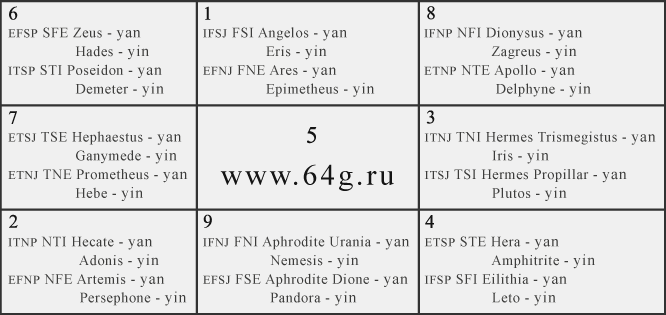
Four mental functions form eight algorithmic patterns. But eight algorithmic patterns in aggregate with psychophysical orientations of human personality are basis of 16 psychological types. Namely sixteen complex combinations which are psychological types or otherwise to tell psychotypes of human person in the context of analytical psychology of Carl Gustav Jung and socionics of Aushra Augustinavichjute, also typological indicator of Isabel Briggs-Myers, that is shown on the chart.
-
Names of Greek gods in cells of magic square on the chart are pseudonyms and
mythological images of sixteen psychological types.
To each psychological type there correspond mythological images of two gods of
Olympic pantheon of Ancient Greece, that is possible to compare with qualities
Yan and Yin in the context of Chinese philosophy of Taoism.
Psychological types of quality Yan have formation as a result of strong-willed
overcoming of intensive resistance of surrounding environment.
Psychological types of quality Yin have formation as a result of passive
existence and extensive resistance of surrounding environment.
Combinations of alphabetic letters in cells of magic square correspond to
designations of 16 psychological types in the context of typological indicator
of Isabel Briggs-Myers.
F - ethics. T - logics. N - intuition. S - sensory.
I - introversion. E - extraversion. J - rationality. P - irrationality.
Sensory types - digits 6 and 4 of analytical numerology.
Zeus and Hades - number 6.
SFE - sensory-ethical extravert.
EFSP - extraversion - ethics - sensory - irrationality.
Poseidon and Demeter - number 6.
STI - sensory-logical introvert.
ITSP - introversion - logics - sensory - irrationality.
Hera and Amphitrite - number 4.
STE - sensory-logical extravert.
ETSP - extraversion - logics - sensory - irrationality.
Eilithia and Leto - number 4.
SFI - sensory-ethical introvert.
IFSP - introversion - ethics - sensory - irrationality.
Intuitive types - digits 2 and 8 of analytical numerology.
Hecate and Adonis - number 2.
NTI - intuitive-logical introvert.
ITNP - introversion - logics - intuition - irrationality.
Artemis and Persephone - number 2.
NFE - intuitive-ethical extravert.
EFNP - extraversion - ethics - intuition - irrationality.
Dionysus and Zagreus - number 8.
NFI - intuitive-ethical introvert.
IFNP - introversion - ethics - intuition - irrationality.
Apollo and Delphyne - number 8.
NTE - intuitive-logical extravert.
ETNP - extraversion - logics - intuition - irrationality.
Ethical types - digits 1 and 9 of analytical numerology.
Angelos and Eris - number 1.
FSI - ethical-sensory introvert.
IFSJ - introversion - ethics - sensory - rationality.
Ares and Epimetheus - number 1.
FNE - ethical-intuitive extravert.
EFNJ - extraversion - ethics - intuition - rationality.
Aphrodite Urania and Nemesis - number 9.
FNI - ethical-intuitive introvert.
IFNJ - introversion - ethics - intuition - rationality.
Aphrodite Dione and Pandora - number 9.
FSE - ethical-sensory extravert.
EFSJ - extraversion - ethics - sensory - rationality.
Logical types - digits 7 and 3 of analytical numerology.
Hephaestus and Ganymede - number 7.
TSE - logical-sensory extravert.
ETSJ - extraversion - logics - sensory - rationality.
Prometheus and Hebe - number 7.
TNE - logical-intuitive extravert.
ETNJ - extraversion - logics - intuition - rationality.
Hermes Trismegistus and Iris - number 3.
TNI - logical-intuitive introvert.
ITNJ - introversion - logics - intuition - rationality.
Hermes Propillar and Plutos - number 3.
TSI - logical-sensory introvert.
ITSJ - introversion - logics - sensory - rationality.
Read information about characters of Olympic
gods of Greek mythology on pages of this website in section which is
named as numerology.
Or read information about characters of Greek mythological gods in myths of
Ancient Greece.
Also it is possible to read information about parameters of psychological types
from books of socionics and to compare with characteristics of Olympic gods in
Greek myths.
Pay attention that in each cell of magic square one psychological type is
extraverted and second is introverted. But numbers 3 and 7 are connected with
cells where psychological types are only introverted or only extraverted, that
corresponds to positions Prometheus with Hebe and Hermes Trismegistus with Iris.
Hermes Trismegistus with Iris should be logical-intuitive extraverts, but
actually are introverts.
Prometheus with Hebe should be logical-intuitive introverts, but are extraverts.
Inappropriate positions of Prometheus with Hebe and Hermes Trismegistus with
Iris are caused by universal law according to which numbers of Pythagorean
numerology form circular cycle or ring sequence, that is shown on the chart.
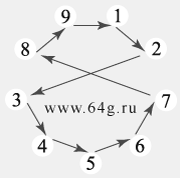 |
Circular sequence of nine numbers in Pythagorean numerology is not correct circle, but complex geometrical figure which is similar to Mobius band or Moebius strip and mathematical sign of infinity, that is display of universal law according to which Universe is constructed and structure of human consciousness is organized. |
This universal law of Universe also is fixed in circular sequence of eight trigrams or mystical symbols Ba Gua of Chinese Canon of Changes I-Jing, that is shown on the following chart.
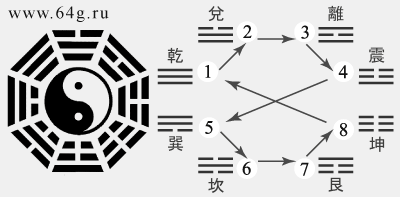 |
The shown circular cycle or sequence of eight trigrams or symbols Ba Gua of the Canon I-Jing has been created by Fu Hsi or Pao-Hsi who was legendary emperor of ancient China and founder of Chinese civilization. |
Following page shows analytical charts according to which gods in Olympic pantheon of Greek mythology and magic numbers of Pythagorean numerology correspond with mental functions of sixteen psychological types of human personality.
-