Page 8.
|
|
Square of magic Olympic pantheon and numbers. Information of this page can be interesting not only for researchers of esoteric knowledge of Greek philosophy and mystical theories of Pythagorean numerology, but also for scientists who are engaged in mathematics and physics or astrophysics, because mythological gods of Olympic pantheon of Ancient Greece and numbers correspond with physical and mathematical laws of Universe. |
-
As a result of complex evolution of universe and occurrence of ethereal space there was celestial formation of Olympic pantheon of various gods who have formed hierarchical structure which is connected with magic square or mathematical matrix of nine numbers of Pythagorean numerology. that is shown on the chart.
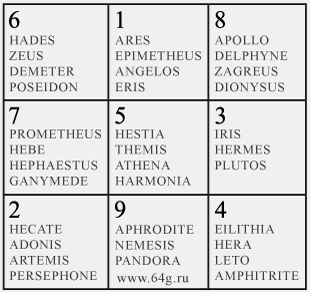 |
Celestial structure of Olympic pantheon has been formed
by divine essences of different categories and generations. 5 - Themis is titaness. 1-7 - Epimetheus and Prometheus were born as children of titaness Themis. 4-5-6 - Hera, Hestia, Zeus, Poseidon, Hades, Demeter were born as children of titans. 4 - Leto is daughter of titans. 1-7-4 - Ares, Angelos, Hephaestus, Hebe, Eilithia were born as children of Zeus and Hera. 2-8 - Artemis and Apollo were born as children of Zeus and Leto. 2-8 - Persephone and Dionysus were born as children of Zeus and Demeter. 3 - Hermes was born as son of Zeus and nymph. 7 - Ganymede was born as son of terrestrial king and nymph. 9 - Aphrodite was born as daughter of Zeus and oceanid Dione. 9 - Aphrodite Urania has arisen from blood of Uranus. 9 - Pandora has arisen as connection of psychological characteristics of all gods of Olympic pantheon. 3 - Iris is daughter of oceanid and theriomorphic deity. 3 - Plutos is son of Demeter. 5 - Harmonia is daughter of Ares and Aphrodite Dione. 5 - Athena has arisen from head of Zeus. 4 - Amphitrite is nereid. 1-9 - Eris and Nemesis are generations of Nyx. 8 - Delphyne is theriomorphic deity which has been absorbed by Apollo. 8 - Zagreus is mythological god who was born as son of Zeus and Demeter, also brother of Persephone, but he has lost individual consciousness and has been revived as Dionysus. 2 - Hecate is goddess whose mother was born as sister of Leto, dut father is son of titan and theriomorphic deity. 2 - Adonis was born as son of nymph and terrestrial king. |
-
In total to everyone numerological number in cells of magic square in
structure of Olympic pantheon there correspond names of four gods which are
connected with fundamental elements of universe and types of temperament.
Melancholic type - water - humidity and cold - blue color.
Melancholic type of temperament avoids interaction with world around and
involuntary reacts to external influences.
Melancholic person is inactive and motionless, but have unbalanced mood.
Choleric type - fire - dryness and warmly - red color.
Choleric type of temperament aspires to interaction with world around and
dynamically reacts to external influences.
Choleric person is active and mobile, also have unbalanced mood.
Sanguine type - air - warmly and humidity - green color.
Sanguine type of temperament cooperates with world around and voluntary reacts
to external influences.
Sanguine person is active and mobile, but have counterbalanced mood.
Phlegmatic type - earth - cold and dryness - yellow color.
Phlegmatic type of temperament does not cooperate with world around and can be
not subject to external influence.
Phlegmatic person is inactive and motionless, also have counterbalanced mood.
Number 1

Ares ARES corresponds to elements of fire because this deity of Olympic
pantheon personifies aggression and aspiration to interaction which is caused by
demonstration of personal ambitions and need for dialogue, also declarative
manifestation of own force.
Epimetheus EPIM corresponds to elements of air because this Olympic deity
personifies impulsive behavior and aspiration to interaction which is not
aggressive but is caused by personal intellectual ambitions and demonstration of own force.
Alongside with Epimetheus to numerological number 1 and elements of air there
corresponds Heracles who is son of Zeus and terrestrial woman Alcmene, but this
deity has been taken in celestial pantheon of Olympic gods as divine award for feats.
Eris ERID corresponds to elements of water because this Olympic goddess
personifies latent aggression and compelled interaction which are caused by
mental reactions on insult of personal ambitions.
Angelos ANGL corresponds to elements of earth because this female deity
of Olympic pantheon personifies indifference and denying of interaction, and in
essence unconditional statement of personal egoism.
Angelos considers own exterior as the most beautiful and she does not react to
public opinion according to which Aphrodite is personification of perfect
beauty, that differs from Eris who perceives herself as ugly and consequently
caused contention of three goddesses which were considered as the most attractive.
Angelos has lost own beauty when has escaped from Hera in subethereal reality of
universe, but however this mythological deity considers own exterior as the most
beautiful and does not react to public opinion.
Angelos similarly to Epimetheus makes impulsive and rash acts, because she has
stolen fragrant ointments at Hera, that caused flight in subethereal reality.
Ares and Eris too make impulsive and rash acts, that is general characteristic
of number 1 in the context of Pythagorean numerology.
Number 2
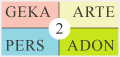
Hecate GEKA corresponds to fire because divine attribute of this
celestial goddess of Greek mythology is magic torch burning in night darkness.
Artemis ARTE corresponds with earth because she is celestial ruler of
natural kingdom of terrestrial plants and animals, or otherwise to tell
mythological goddess of flora and fauna.
Persephone PERS corresponds with water because this deity of Olympic
pantheon personifies spring awakening of nature and growth of plants, that is
real when substation of ice turns to moisture, namely there is transition of
water elements of universe from firm into liquid condition.
Adonis ADON corresponds to air because this Greek deity personifies
transformation of water into steam as a result of breath which is life basis of
animals and plants.
Adonis was born as son of Alphesiboea or Smyrna who is nymph of a myrrh-tree, and he has in
essence arisen as fragrant pitch which ancient civilizations applied for
embalming dead. And consequently Adonis is mythological god who personifies
immortality of alive organic matter, and in essence he is personification of
imperishable beauty and immortality which is possible as a result of integrated
unity or otherwise to tell ideal love of two individualities, that have
something in common with psychological characteristics of Hecate who is goddess
of sexual magic.
Aphrodite Urania has taken away Adonis from mother and has given on education to
Persephone, but Artemis too wished to be his teacher, and therefore
irreconcilable conflict of two goddesses became inevitable reason for death of
this mythological deity. And in essence all gods of Olympic pantheon of Ancient
Greece have been interested in death of Adonis, because as a result of sacred
union with Aphrodite Urania there could be real integral unity of polar mental
functions of human consciousness. Namely there could be real transformation of
discrete material substance which has been created by Hera and forms substantial
basis of ethereal space, also physical reality of universe.
Father of Adonis was terrestrial king whose name in myths of Ancient Greece
corresponds with denomination of mythical bird Phoenix which burns itself before
ending of life and then revives from ashes as immortal being.
Number 9

Aphrodite Urania AURA corresponds to fire because this Olympic goddess
personifies love energy which is equivalent to fiery elements of universe.
Aphrodite Dione ADIO corresponds to water because this goddess of Greek
mythology is wife of Hephaestus or lame god who is the smith and corresponds
with fiery elements of universe.
Matrimonial attitudes of Hephaestus and Aphrodite Dione correspond to
combination of fire and water.
Energy of water calms elements of fire.
Elements of fire raises energy of water.
Nemesis NEMA corresponds to air because she is mythological goddess of
punishment which can be caused by conscience or personal spirit, that
corresponds with aerial elements of universe.
Alongside with Nemesis to numerological number 9 and elements of air
there corresponds charite Pasiphea who is personification of dreams about
perfect love and wife of Hypnos.
Pandora PAND corresponds to earth because this Greek deity is connection
of positive and negative characteristics of all gods of Olympic pantheon, that
is comparable with complex combination of diverse chemical elements of material
substance or physical matter.
Alongside with Pandora to numerological number 9 and elements of earth there
corresponds terrestrial woman Pasiphae who was wife of Minoan king Minos and
reason for birth of monstrous Minotaur as a result of conjugal connection with
Poseidon who rules over water which dissolves and mixes molecules of
chemical elements of material substance and as a result there are creation of
diverse forms of life.
Similarly Aphrodite Urania was born from sea froth which has resulted from
mixing of blood drops of mythological Uranus with water.
Number 3

Iris IRID corresponds to air, because this deity of Olympic pantheon is
sister of winged harpies which exist in empire of Hades and personify various
shapes of fiery-air whirlwinds or storms of flame.
Iris similarly to harpies is winged mythological goddess, also she is personification of
iridescent spectrum of rainbow which arises when sun beams refract in atmosphere
of the Earth. Namely when hot sunlight becomes multi-color in the sky which is
sated by small drops of rain, that corresponds to warm and damp qualities of air elements.
Hermes Trismegistus GERT corresponds to fire as the god who is celestial
conductor of human souls into infernal fiery empire of death.
Trismegistus or "thrice-greatest" is epithet of Hermes, and in essence
philosophical denomination of divine essence which is partial image of this mythological god.
Hermes Trismegistus possesses winged sandals as messenger of divine will or
celestial herald alongside with Iris who corresponds to air elements of universe.
Also Hermes Trismegistus is destiny guide who possesses miraculous caduceus or
magic staff which is reason of illusive dreams of consciousness and mystical
omens of future events, that is comparable to mythological qualities of Hypnos
who too corresponds with number 7 in the magic square of Pythagorean numerology.
But mythological Hypnos corresponds to water elements of universe.
Hermes Propillar GERP corresponds to earth, because this deity of Ancient
Greece is connected with geodetic coordinates and geographical reference points
of terrestrial surface.
Propillar or "gatekeeper" too is epithet of Hermes, and in essence philosophical
denomination of divine essence which is second part of one mythological god.
It is possible to assume that Propillar and Trismegistus are epithets of
twins which have one denomination Hermes, that is equivalent for two cosmic
brothers Ashvins who have no individual names in the context of ancient Vedic mythology.
Hermes Propillar is guard of gates and spatial guide who in the Ancient Greece
was identified with milestones or road signs.
Word GUIDE in English language has semantic values which correspond to
parameters of Hermes Propillar: scout - adviser - reference point - directory - management.
Or it is possible to assume that Hermes Propillar corresponds with water
as equivalent of Roman Mercury, namely mythological deity of trade and commercial benefit, also
as chemical mercury or liquid metal from the view point of alchemy.
Plutos PLUT corresponds to water as mythological deity of wealth
prosperity, or otherwise to tell economic success and augmentation of financial
capitals which can be compared to riches of Poseidon, namely infinite treasures
of sunk ships which have for ever remained in sea depths.
Name of this god of Greek mythology is equivalent of Pluto who is ruler of fiery
infernal empire of death in myths of ancient Rome.
Also Plutos as deity of Olympic pantheon is son of goddess Demeter who rules
over earth or terrestrial elements of universe.
Number 6
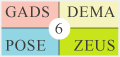
Hades GADS corresponds to fire because he is Olympic ruler of fiery empire of death.
Hades possesses choleric temperament, namely he aspires to interaction with
world around and is interested in responses to influence. But according to
celestial lot this deity has received in possession underground empire of death
and silence, and consequently he is inadequate or otherwise to tell unobvious
god who could be dominant in structure of Olympic pantheon as ruler over
universe instead of Zeus.
Therefore Hades possesses magic helmet by means of which this Olympic deity can
be invisible for people and gods.
Zeus ZEVS corresponds to air because according to celestial lot this
Olympic deity has received in possession heavenly space. But Zeus is celestial
judge which punishes people and gods, and as a result he dooms to destruction in
empire of dead, that is equivalent to Hades.
Demeter DEMA corresponds to earth because she is Olympic goddess of
fertility and agriculture.
Demeter is mythological organizer of agrarian laws of human society, namely she
pays attention to terrestrial needs of people but possesses phlegmatic
temperament, and consequently can not cooperate with world around, and can be
not subject to external influence. Therefore ground of terrestrial surface some
years did not bring crops when Demeter mourned over absence of own daughter
Persephone which has been stolen by Hades.
Poseidon POSE corresponds to water because this deity of Olympic pantheon
according to celestial lot has received in possession sea space of universe, but
he challenges ruling rights of world supremacy with gods who possess authority
on terrestrial surface. In particular Poseidon wished to dominate over town of
Athens and argued with goddess Athena, or he wished to possess Delphi and
competed to Apollo.
Therefore Poseidon is celestial reason of earthquakes though he rules over water
elements of universe.
Attitudes of Poseidon with Demeter are favorable because water is substantial
source of terrestrial fertility.
Sacred animals of Poseidon are horses who symbolize melancholic type of
temperament, namely beasts which are quiet and do not aspire to interaction with
world around, but can roughly react to external influences.
Number 4
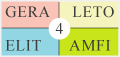
Hera GERA corresponds to fire but this deity of Olympic pantheon of
Ancient Greece is lawful wife of Zeus who rules over aerial elements of universe.
Hera is mother of lawful children which were born in matrimonial union with
Zeus. Also Hera has given birth to one illegal child and pursues children who
have been born by other goddesses in unions with Zeus outside of lawful
matrimonial attitudes, and in particular she was adversary of Heracles.
Therefore psychological parameters of Hera can be compared with fire elements of
universe and attributes of choleric temperament.
Or psychological parameters of Hera can be compared with attributes of
melancholic temperament because Homer in epic poems of Iliad has named this
goddess of Greek mythology as ox-eyed, that corresponds to physiognomic features of melancholy.
Amphitrite AMFI corresponds to air but this goddess of Greek
mythology is wife of Poseidon who rules over liquid substance of universe.
Because Amphitrite leaves depth of sea and cooperates with other gods, and
Poseidon remains in space of water elements.
Amphitrite is mother only lawful sons and daughters, but she does not reproach
Poseidon who is father of many gods and goddesses who was born outside of lawful
matrimonial attitudes.
Therefore psychological parameters of Amphitrite can be compared with air
elements of universe and attributes of sanguine temperament.
Leto LETO corresponds with earth, because this Greek goddess should step
on ground that twins Apollo and Artemis were born. Namely Hera has forbidden
Leto to go on firm ground that prohibited from childbirth, but as a result
Apollo and Artemis were born on floating island.
Leto is illegal wife of Zeus and mother of illegitimate children, and also she
has no sons or daughters who was born outside of amorous attitudes with Supreme
Olympic god.
Therefore psychological parameters of Leto correspond to attributes of
phlegmatic type of temperament.
Eilithia or Eileithia ELIT corresponds to water because this deity of
Olympic pantheon personifies insuperable physiological reactions of female
organism during birth of children.
Eilithia has no own children and lawful matrimonial attitudes because she is
daughter of Hera, namely she is connected with mother who has choleric
temperament and corresponds to fiery elements of universe as egocentric and
capricious goddess.
Therefore psychological parameters of Eilithia can be compared with water
elements and attributes of melancholic temperament.
Number 7

Hephaestus GEFS corresponds to fire as the smith.
Prometheus PROM corresponds to earth because this mythological god of
Olympic pantheon has taken divine spark of fiery energy from smithy workshop of
Hephaestus and has given people. And as a result mythological Prometheus has
been chained to a rock in subethereal space which adjoins to
physical reality of universe.
Hebe GEBA corresponded to air, because this mythological goddess carried
out functions of cupbearer and regulator of mutual relations in hierarchy of
Olympic gods, or otherwise to tell she was celestial organizer of balanced
informational interaction which is caused by proportional interrelations of
mental waves of diverse divine essences in heavenly diapason of cosmic space,
that corresponds to aerial elements of universe.
But Hebe began to correspond to water when became wife of Heracles.
Also Hebe became celestial keeper of ambrosia which is divine source of power
and immortality of gods.
Before ambrosia was kept by Tantalus who has been taken by Olympic gods on the
sky. But Tantalus has been subverted into infernal empire of death where this
mythological deity is immersed into waters of underground river and cannot get
drink.
Tantalus is son of Zeus and Phrygian queen Pluto whose name is comparable to
mythological Plutos who is deity of financial capitals and corresponds with
number 3 as opposition of Tantalus within magic square of
Pythagorean numerology.
Tantalus has been taken in hierarchical square of Olympic pantheon for
role of honest keeper of heavenly ambrosia which is source of divine power and
common property of gods. But Tantalus wished to steal heavenly ambrosia and to
give people, and as a result this deity of Olympic pantheon has been
subverted into infernal empire of death, that is comparable to self-sacrificing
act of Prometheus but is caused by other motives.
Prometheus has stolen heavenly fire as gift which is necessary for evolutionary
development of human civilization.
Tantalus has stolen heavenly ambrosia and esoteric secret about eternal youth
when Olympic gods have not wanted to revive his died son.
Ganymede GANY corresponds to air because this mythological deity instead
of Hebe carries out function of cupbearer and regulator of proportional mutual
relations in hierarchy of Olympic gods of Ancient Greece.
Number 8
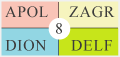
Apollo APOL corresponds to fire because he has epithet Phoebus, that
means "radiance" of sunlight, namely this Greek mythological god is similar to
the Sun which is celestial source of fiery elements of universe.
Delphyne or Delphinios DELF corresponds to air because this deity of
Ancient Greece has theriomorphic appearance like a winged dragon.
Delphyne protected Delphian Oracle which from the view point of
mythology of Ancient Greece was epicenter for propagation of celestial
information in space of physical reality, that corresponds with aerial elements of universe.
Delphyne became Typhon because he has been incinerated or absorbed by radiance of Apollo.
Apollo after absorption of Delphyne too corresponds to air because this radiant
deity personifies creative inspiration which can be caused by free movement of
mental informational waves, also he is celestial carrier of prophetic capability
which can be caused by unlimited propagation of divine information in cosmic
space of universe.
It is possible to tell that mythological image of Apollo Phoebus personifies
radiant beams of fiery sunlight which penetrates universe and is all-seeing. But
mythological image of Apollo Delphinios personifies celestial combination of
fiery sunlight with mental waves of consciousness and aerial stream of
information in cosmic space of universe.
Dionysus DION corresponds to water because this mythological god in
hierarchy of Olympic pantheon is brother of Persephone who personifies spring
awakening of nature and corresponds with liquid substance of universe.
Also Dionysus is Greek god of winemaking or grape juice which can be compared to
water elements of universe.
Zagreus ZAGR corresponds to earth because this Olympic deity is son of
goddess Demeter who rules over eartherial elements of universe.
Hera has taken away individual consciousness of this Olympic god, but titaness
Rhea has returned mental reason and after that Zagreus has realized himself as Dionysus.
Namely Zagreus was born as son of Demeter and brother of Persephone but then he
became Dionysus, and as a result there was alteration of psychological parameters.
Epithet of Dionysus was enthusiastic exclamation Iacchus which became as name of
Bacchus in Roman mythology.
Number 5

Hestia GEST corresponds to fire because this mythological goddess of
Olympic pantheon is celestial keeper of inextinguishable flame which symbolizes
stable harmony of cosmic space.
Hestia is Supreme Olympic goddess and corresponds with number 6, but she
complies with fifth fundamental elements or fiery ether which is central axis of
ethereal reality of universe. Therefore Greek goddess Hestia in structure of
Olympic pantheon and magic square of Pythagorean numerology is projected on central number 5.
Themis FEMA corresponds to water as one of Zeus wives.
Hera as wife of Zeus corresponds to fire.
Demeter as wife of Zeus corresponds to earth.
Themis as wife of Zeus corresponds to water.
Metis as wife of Zeus corresponded to air. But Metis has been swallowed by Zeus
together with the child who was not born but could overthrow authority of
Supreme Olympic gods.
Athena AFIN corresponds to air, because this mythological goddess was
born as idea from head Zeus and daughter of Metis who had correspondence with
air elements of universe.
Harmonia GARM corresponds to earth, because she is Olympic goddess who
harmonizes manifestations of her four brothers which were born as children of
Aphrodite Dione and Ares. Namely Harmonia possesses qualities of terrestrial
elements of universe and psychological parameters of phlegmatic temperament
which allows to neutralize destructive interrelations
among terror of Phobos and horror of Deimos, also sympathy of Erotus and
antipathy of Anterotus, that is shown on the chart.
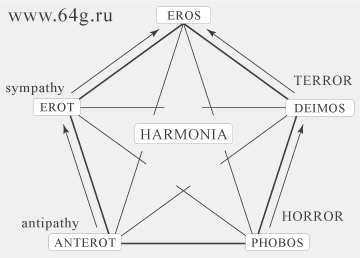 |
At top of pentagonal figure is Eros which is
culmination aim or purpose of aspirations and desires, or otherwise to
tell extreme intention of passion which corresponds to semantic value of
Greek word Pathos and is derivative of five apexes of pentagon. Realization of Eros is a reason of coordinated interrelations among divine essences, and actually Sacred Marriage or Hierogamy can be real, that corresponds to mystical value of number 10. Also unitary connections of divine essences can be formed at realization of Eros, and actually Syzygy can be real, that corresponds to mystical value of number 11. Look information about mystical values of numerological numbers 10 and 11 on 5th page in this section of website. |
Four bottom apexes and center of pentagonal figure correspond to children of
Aphrodite Dione and Ares.
Anterotus - antipathy - antagonistic attitudes of gods - hostility -
disgust - detestation - abhorrence.
Erotus - sympathy - associated attitudes of gods - attraction -
fascination - charm.
Phobos - fear - depressive attitudes of gods - extreme danger -
inevitable threat - ghastly fright.
Phobos personifies mental parameters of fear which is equivalent to semantic
value of Latin word Horror .
Deimos - awe - expressive attitudes of gods - reverential trembling -
intolerable dread - shocking catalepsy.
Deimos personifies mental parameters of awe which is equivalent to semantic
value of Latin word Terror.
Realization of Eros can be possible if attitudes of gods are associated or
expressive, namely there correspond with sympathy of Erotus or terror of Deimos.
If attitudes of gods are antagonistic or depressive, namely correspond to
antipathy of Anterotus or horror Phobos, then should become associated or
expressive that realization of Eros could be possible. Namely terror should deny
horror or sympathy should reject antipathy that realization of Eros could be possible.
If horror or antipathy are aimed at realization of Eros then are blocked by
goddess Harmonia in the center of pentagon.
If antipathy provokes terror then is blocked by goddess Harmonia.
If horror provokes sympathy then is blocked by goddess Harmonia.
If terror directs to identification with sympathy then is blocked by goddess Harmonia.
If sympathy directs to identification with terror then is blocked by goddess Harmonia.
Blocking of destructive interrelations within pentagon is possible because
goddess Harmonia possesses attributes of phlegmatic temperament which which does
not react to external influences and avoids interaction with world around.
If goddess Harmonia does not carry out own function then there can arise
hysterics and psychopathic frustrations of personality, or otherwise tell
pathological distortions caused by disharmony.
If goddess Harmony carries out own function, but realization of Eros is not
carried out, then there can be ascetic ataraxia or otherwise tell phlegmatic impassivity.
Athena, Hestia and Themis are equal to Harmonia and consequently too can block
destructive interrelations of pathological children of Aphrodite Dione and Ares
in the center of pentagon, but differently because three equivalent goddesses
correspond with other fundamental elements of universe and types of temperament.
In particular if blocking functions of Harmonia are carried out by the goddess
Themis, but Eros is not carried out, there can be apathy or otherwise tell
melancholy. Because Themis is connected with water elements of universe and
melancholic type of temperament.
Deimos, Phobos, Erotus and Anterotus do not possess concrete parities with
numbers of Pythagorean numerology and consequently can be shown as mental
reactions of any gods at Olympic pantheon, but except four goddesses in the
center of magic square.
More detail information about pathological children of Aphrodite Dione and
Ares, also about hysterics and psychopathic frustrations which can be considered
as not realized preconditions of Sacred Marriage or omens of Syzygy, I shall try
to publish in the future.
Pay attention that Harmonia,
Deimos, Phobos, Erotus and Anterotus can be compared with
Eilithia, Ares, Hephaestus, Hebe and
Angelos which were born as children of Hera.
Following page gives information about ratio of numbers with alphabetic letters and names, also about numerological calculations according to which it is possible to correlate characteristics of mythological gods of Olympic pantheon of Ancient Greece within magic square of Pythagorean numerology to psychological parameters of people.
-