



-
Open numbers on a chess board.
Numerical playing cards.
Rules on this page allow to familiarize with a design of the present
mathematical game, but do not exhaust all variants of playing interactions which
are possible by means of the offered game device.
All Russian texts of game
rules and instructions look in PDF files.
och1.pdf - och2.pdf - och3.pdf
-
Rules of numerical game 1st.
Rules are based on correlations of numbers on playing cards with numerical
notation on the chess board.
Use chess board and complete set of numerical cards of the big version.
Two players participate in game.
Preliminary 100 used cards shuffle or mix and have in a closed pile, then each
player in turn opens one card from a pile and
lays on squares, and focus arrows on the opponent to distinguish own cards by means of
arrows, provided that players are opposite each other.
Colors of numerical cards has no value in this game, and consequently players
distinguish own and another's cards by means of focusing arrows.
It is authorized to lay on squares where numbers of cards grow from
mathematical actions with numerical notations of the board. Namely player
chooses any vertical and horizontal where mathematical addition or
multiplication or division or subtraction with digits of
notations gives number on the card, and lays on the square in crossing. And it
is possible to divide vertical num by horizontal or horizontal num by
vertical, and also it is possible to subtract similar.
And also it is possible to lay on squares where vertical and
horizontal digits correspond to tens and units in numbers of cards.
For example, num 24 can be laid on squares which
are marked by daggers on picture 1.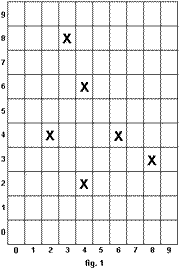
Number 24 contains two tens and four units, and consequently this numerical card can be
laid in crossing of second vertical with fourth horizontal, or in crossing of
fourth horizontal with second vertical.
Or mathematical multiplication 6х4 =24 and 8x3 =24 allow to put this card
in crossings of sixth and fourth or eighth and third horizontals and verticals.
It is authorized to lay on free squares, but according to different variants of game rules
can be possible to lay on squares with other cards.
Game is finished when all cards from a closed pile are laid.
That player wins who has more cards on the chess board, but players count only those
own cards which are not covered by others.
Rules of numerical game 12th.
Rules are based on covering cards.
Use the game board and decks of numerical cards of the
small version, but use cutting decks with numbers from 0 to 15 which
preliminary have in initial gaming positions
shown on picture 3,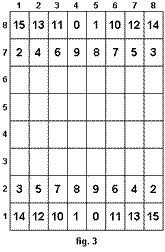 namely cards of one player on 1-2 horizontals, and cards of opposite
player on 8-7 horizontals. Gamers play own decks which differ by means of colors.
namely cards of one player on 1-2 horizontals, and cards of opposite
player on 8-7 horizontals. Gamers play own decks which differ by means of colors.
Game rules consist that players by turns move any own card on next squares over
verticals or horizontals or diagonals, and at that can beat (cover) cards of opponent.
Bigger numbers can beat smaller, and also playing cards can beat
each other if numerical signs have identical ciphers.
For example, num 5 can beat 15 as both have cipher 5, but can not beat num 9 because 5 is less than 9.
Beaten cards remove from the chess board.
The task of game consists that each player needs to beat the opponent's card with number 0.
• It is possible to apply cutting proportional groups of numerical cards from
the complete set of big gaming version and appropriate 100-square chess board
for which initial playing positions are shown on picture 4. In this case
numerical cards with 0 and 1 are test figures which overturn backs and
can be beaten irrespective of numbers to win.
Or cutting proportional groups of the big version preliminary can be
arranged on the 64-square board of small gaming version in initial
playing positions as shown on picture 5.
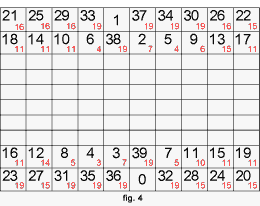
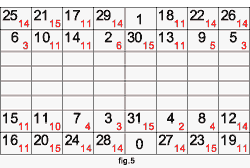
Pictures 4 and 5 show numbers of cards by dark color, and red digits designate
forces. For example, num 21 can beat 16 cards of opponent that is the force
which is designated by red digit. Total cumulative forces in proportional groups
are 251 and 254 on picture 4, or 157 and 158 at game on 64 squares at picture 5.
This fact specifies approximate equality of forces in the shown initial
positions, that matters if distance of moving is any quantity of squares
over verticals or horizontals or diagonals, as a chess queen have. And if cards
according to game rules have
distance of moving on next squares as a chess king then it is possible to have
casual initial playing positions.
-
Rules of numerical game 14th.
Rules are based on formation of numerical combinations.
Two players participate in game.
Use chess board and decks of numerical cards of the
small gaming version, but use sets with quaternary numbers. Namely choose cards
with points on backs.
Each gamer plays by own deck.
Cards with number 0 of first and second players have on royal squares on which
chess kings have. These numerical cards are test figures.
Then shuffle other cards and display on 1-2 horizontals for first gamer and on 8-7 horizontals
for second player on opposite halves of the board in casual order.
Or for preliminary arrangements of numerical cards it is possible to use initial
playing positions which are shown on picture 8.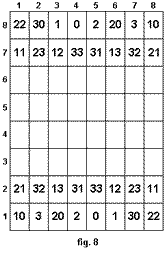
Game rules consist that players by turns move own cards on next squares over
verticals or horizontals or diagonals. If numerical combinations are formed
during moving then players remove cards of opponent from these combinations.
Numerical combinations are sequences of ciphers 0-1-2, 1-2-3, 0-1-2-3, and also
unions of identical ciphers 0-0-0, 1-1-1, 2-2-2, 3-3-3. Namely combinations are as minimum three cards
which are located in vertical or horizontal or diagonal row if in numbers of
cards there are ciphers which form the listed sequences or unions. For example,
row of numerical cards with numbers 31-20-33 form the combinational sequence of
ciphers 1-2-3.
If as a result of moving several combinations are formed on verticals and
horizontals and diagonals then gamer removes from the board all opponent's cards
which are available in all combinations.
The task of game consists that each player needs to impose any own card on the
test figure of opponent. Namely cards are not imposed on each other during game, as
the basic rule is formation of numerical combinations, but it is necessary to impose on test
cards with number 0. Provided that test figures can move the same as others.
Rules of numerical game 21st.
Rules are based on different ranges (diapasons) of card moving.
Two players participate in game.
Use sets of playing cards with seven-symbol numbers from two decks of the gaming version
with inverse numerical order and the appropriate chess board. Namely choose
numerical cards with daggers on backs.
Each gamer plays by cards of own deck which preliminary have
in initial playing positions shown on picture 10.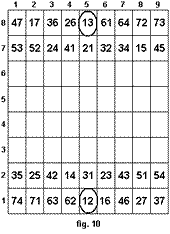 Or it is possible to apply other variants of initial positions.
Cards with numbers 12 and 13 overturn by backs upwards and use as test figures.
Game rules consist that players by turns move own cards over squares of chess
board according to ranges which are specified by numbers. For example, num 65
can be moved on distances of 6 or 5
squares over verticals or horizontals or diagonals, as this numerical card has ciphers 6 and 5.
Moving is possible over squares on which there are other cards.
If as a result of moving your card is imposed on any card of opponent then you
exclude it from game.
Values of numbers at imposing do not take into consideration. Namely numbers specify ranges of card moving and do not determine imposing.
The task of game consists that it is necessary for each player to impose any own
card on the test figure of opponent, provided that test figures can move
on next squares over verticals or horizontals or diagonals as chess kings, but
they can not be imposed on other cards.
• It is possible to play variant of this game as puzzle in which moving atop of other cards is not authorized. Namely in this case it is necessary to move over squares on which there are no other cards, and it is possible to impose on other cards on squares where moving stops.
Rules of the listed numerical games represent only some opportunities
according to which mathematical numbers can be used as playing objects, and
rules show the most obvious gaming which can be played by means of the offered
digital design. The listed games sometimes are similar to the chess, but the
manual in PDF files describes many variants which are not similar to
the chess-gaming but also give equal odds of a prize and open playing information.
And also the manual describes various mathematical puzzles which are possible by
means of numerical cards on a chess board.
In total the manual contains descriptions and instructions of 50 mathematical games and puzzles, and each game has some variants.
The manual is written in Russian language.