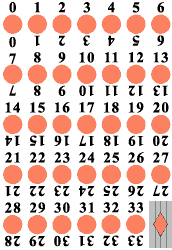
The first deck of numerical cards.
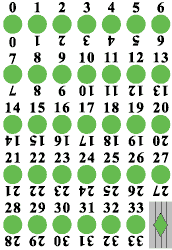
The second deck of numerical cards.
Quaternary numbers:
0 1 2 3 10 11 12
13 20 21 22 23 30 31 32 33
- playing cards with these numbers are designated by points on back sheets.
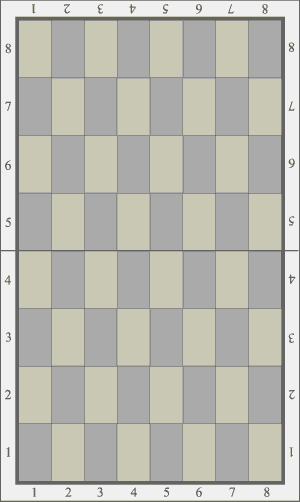
Gaming chess board.
64 squares correspond to two decks of numerical playing cards of the small game version.
 |
Description of numerical construction.
Playing cards with numbers.The small version of the present mathematical gaming contains two decks
of 34 numerical playing cards in each with
numbers from 0 up to 33. Numbers are put on playing cards in the direct
and turned positions that allows two players to read numerical signs
directly at opposite sides of a game board.
Two-color circles on face sheets and multi-colored rhombuses on backs designate
belonging of playing cards to different decks that allows two players to
distinguish decks.
Points on back surfaces designate playing cards with numbers in which there
are ciphers 0, 1, 2, 3 and there are no ciphers 4, 5, 6, 7, 8, 9. These
numbers are called "quaternary" or "fourfold" or "quadruple" and
accordingly points designate playing cards with quaternary numerical signs which
are necessary for realization of some game rules which are based on formation
of digital combinations.
The game board of the small version has 8 vertical and 8 horizontal rows
that forms 64 squares as a chess-board or a checker-board. Verticals and
horizontals have numerical notations. Squares have dark and light colors that
allows to see diagonals.
The constructive design of such mathematical gaming allows to carry out various
rules and instructions of mathematical games and puzzles.
Namely gamers can spread or shift or move numerical
cards on squares of a chess board and make
playing interactions according to digital values and identical ciphers
in numbers. Big numbers can beat smaller, and
also playing cards can beat each other if have identical ciphers of
which numbers consist.
For example, 7 can beat 17 as both have cipher 7, but can not 9 as number 7 is less than
9. The playing card with 9 can beat 7, but can not 17 as number 17 is
more than number 9. Such hierarchy of playing cards is connected not
only with mathematical values but also with ciphers or digits of which numbers consist.
Besides it is possible to play rules of mathematical games and puzzles in which interaction of
numerical cards occurs according to combinations
which are formed by sequences of numbers on next squares, that somewhat
similarly to combinations or hands of cards in poker, but occurs during
math games on a chessboard.
Arithmetic actions in a context of the small version of the present
numerical game are inexpedient, as the big version of playing cards with
numbers from 0 to 99 and digital notations of verticals and horizontals
from 0 to 9 on a chess board for this purpose is intended. But the small version is expedient for games
and puzzles where gamers move numbers on squares as playing figures of chessmen.
Namely the big version is expedient for games in which players consider
numbers on cards as results of mathematical actions with numerical
notations of verticals and horizontals on a board, and the small version
is expedient then gamers move numerical cards on
squares as figures of chessmen and make
playing interactions according to digital values or combinations. But nevertheless both
gaming versions can be used for realization of various rules
Brief rules and instructions of several games and puzzles look on one
page of this website, or look PDF files with rules in Russian. But also
images for printing of numerical cards and game boards there are in PDF
files. OCH2.PDF
Game rules and instructions are written in Russian but in this PDF file there are images
or pictures which can be used to play. -
I hope that this mathematical board game with numerical
cards will be interesting and entertaining!
The shown small version of mathematical game with numbers can be
considered as the intellectual construction toy kit or a set of logic
puzzles for game programs in children's clubs and pedagogical
educational centers of creative development for children. As
intellectual development of creative abilities of children by means of
the present desktop mathematical game can be carried out in the game
form, that allows to interest attention of kids in cognitive gaming
process which is entertaining education, but
which simultaneously develops logic thinking and creative potential of
children brains, and also trains memory and teaches in elementary rules
of mathematics. |



